NEWS
02
2025
-
07
Determination of boric acid content in electronic component solutions by potentiometric titration
Preface
Boric acid serves as a PH buffer in the electroplating solution for electronic components. It is an essential component in the electroplating solution to prevent sudden PH increases or decreases during the electroplating process, which may affect the quality of electroplating.
This method uses sodium hydroxide as the titrant, enhances the acidity of boric acid with mannitol, and employs a PH composite electrode as the measuring electrode. The content of boric acid in it is detected by the JH-T6 fully automatic potentiometric titrator. The detection results are highly accurate, the detection efficiency is fast, it is easy to operate, and at the same time, it reduces human interference and improves the stability of the detection.
Ii. Instruments and Reagents
2.1 Instruments
JH-T6 fully automatic potentiometric titrator, PH composite electrode, analytical balance, etc
2.2. Reagents
Mannitol (analytical grade), sodium hydroxide standard solution (0.1mol/L), purified water.
Iii. Experimental Methods
3.1 Analysis Steps
Accurately measure 1.0mL of the sample with a 1mL pipette into a titration cup. First, add 25mL of water, then 25mL of mannitol solution, and finally 25mL of water. Start the pre-edited method, titrate with the calibrated sodium hydroxide solution until the potential suddenly crosses the endpoint, and record the amount used. At the same time, conduct blank experiments.
The parameters of the titrator are set as shown in Table 1
Table 1 Titration Parameter Settings
Iv. Results and Discussion
4.1 Experimental Results
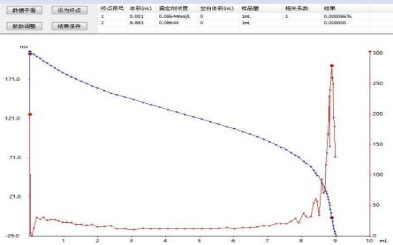
The experimental results are shown in Table 2
Table 2 Test Results
4.2. Conclusion
The determination of boric acid content by potentiometric titration is rapid and has good data repeatability, which improves the accuracy of the detection data and reduces the errors caused by human operation.
References
[1] Wan Zhuo. Detection Methods for Nickel Ions, Chloride Ions and boric acid Contents in Electroplating Nickel Solution [J]. Industrial technological innovation.
Keyword:
potentiometric titration
WELCOME TO JIAHANG
Do you want to Send Inquiry ?

COMPANY CONTACTS
Office Tel: +86-177-2114-8861
E-mail:gm@jiahanglab.com
Factory: NO.3570 Jiasong north Rd, Jiading Dist, Shanghai , China
R&D Sales Center:
13F,BD1,Lane 925, Aksu South Rd, Jiading Dist Shanghai , China
Mob/Whatspp: 0086 177 2114 8861
Copy Right © 2023 Shanghai Jiahang Instruments Co., Ltd. All Rights Reserved
 0086 17721148861
 +86-17721148861
 E-mail