NEWS
17
2025
-
06
The content of monocyanamide was determined by potentiometric titration
I. Preface
Cyanamide, also known as cyanide or urinary anhydride, with the scientific name amino nitrile, is a white orhombic crystalline substance. It is not only an important chemical raw material and organic chemical intermediate, but also a very important pharmaceutical raw material. It can also be used as an intermediate for pesticide products to produce pesticides. In addition, Cyanamide can also be used in the synthesis of health care products, feed additives, pesticide intermediates and flame retardants, etc. Its applications are very extensive. Currently, both at home and abroad, active research on its application is being carried out, and the market prospects are relatively optimistic. Therefore, rapid detection of its content has become a concern for users. In this experiment, the JH-T7 fully automatic potentiometric titration method of Shanghai Jiahang was used to detect its content. The process was simple and the results were accurate.
Ii. Instruments and Reagents
2.1 Instruments
JH-T7 fully automatic potentiometric titrator, volumetric flask, analytical balance, etc
2.2 Reagents
Deionized water, nitric acid solution (25%), sodium borate buffer solution, 0.1mol/L AgNO3 titrant
Iii. Experimental Methods
3.1 Sample Preparation
Weigh about 0.3g of the sample monocyanamide to be tested and place it in a 250mL volumetric flask. Add sodium borate buffer solution and make up to the mark for later use.
3.2 Sample Testing
Determination of free chlorine content
Accurately weigh 2g of the sample to be tested (accurate to 0.0001g), record it as m1, place it in the titration cup, add 60mL of water, insert the rotor and place it on the titration table, turn on the magnetic stirring, adjust the PH of the solution to < 1 with 10mL of 25% nitric acid solution, insert the silver ion composite electrode Titrate with the calibrated 0.1mol/L AgNO3 titration solution until the potential leap point. The volume consumed is recorded as V1.
Determination of the total amount of sediment
Accurately transfer the sample to be tested that has been prepared in the above 1 with a 50mL pipette, place it in the titration cup, insert the rotor and place it on the titration table, insert the compound silver ion electrode, and titrate it with the calibrated 0.1mol/L AgNO3 titration solution until the potential leap point. The volume consumed is recorded as V2. At the same time, conduct a blank experiment. The volume of silver nitrate consumed in the blank test is denoted as V0.
3.3. Instrument Parameters
The parameter Settings of the JH-T7 fully automatic potentiometric titrator are shown in Table 1:
Table 1 Parameter Settings of Titrator
|
Titration mode: |
ynamic titration | a minimum addition volume |
0.02mL |
|
Electrode equilibrium time: |
4s |
Pre-stirring time: |
10s |
|
Electrode equilibrium potential: |
1mv |
Titration spee: |
standard |
|
Final volume: |
20mL |
Pre-titration addition volume: |
0 |
|
Jump: |
300 |
Stirring speed: |
6 |
Iv. Results and Discussion
4.1 Experimental Results
The experimental monocyanamide samples were tested and the experimental results are shown in Table 2 as follows:
Table 2 Test Results of monocyanamide content
4.2 Titration chromatogram
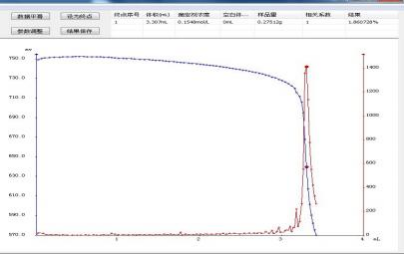
4.3. Conclusion
The content of monocyanamide in this test was 51.105% and the RSD value was 0.591%, with good parallelism of the results.
Notes:
Preparation of sodium borate: Solution A: Weigh 3.092g of boric acid and dissolve it in 250mL of water; Solution B: Weigh 1g of sodium hydroxide and dissolve it in 250mL of water. Solution A + Solution B =1+1. Shake well.
Keyword:
potentiometric titration
WELCOME TO JIAHANG
Do you want to Send Inquiry ?

COMPANY CONTACTS
Office Tel: +86-177-2114-8861
+86150-0214-1603
E-mail:gm@jiahanglab.com
Factory: NO.3570 Jiasong north Rd, Jiading Dist, Shanghai , China
R&D Sales Center:
13F,BD1,Lane 925, Aksu South Rd, Jiading Dist Shanghai , China
Mob/Whatspp: 0086 177 2114 8861
Copy Right © 2023 Shanghai Jiahang Instruments Co., Ltd. All Rights Reserved
 0086 17721148861
 +86-17721148861
 E-mail