NEWS
06
2025
-
06
Determination of chloride ion content in PCB solution by fully automatic potentiometric titration
1. Preface
PCB (Printed Circuit Board), whose Chinese name is printed circuit board or printed wiring board, is the carrier for the electrical connection of electronic components. Because it is made by electronic printing technology, it is called a "printed" circuit board. In the traditional PCB production process, the content of copper ions in the chemical solution directly affects the chemical properties and electroplating performance of the solution itself, and is also closely related to the quality of the product. Therefore, the determination of copper ions in the chemical solution is extremely necessary. In this paper, the copper ion content of PCB solution was detected by potentiometric titration. The operation is simple, the results are accurate and the repeatability is good.
2 Instruments and equipment
2.1 Instruments
JH-T7 fully automatic potentiometric titrator, lead composite electrode
2.2 Reagents
EDTA solution (0.1mol/L), ammonia-ammonium chloride buffer solution with pH=10, purified water
3 Experimental Methods
3.1 Experimental Procedures
Accurately transfer 1mL of the solution sample to the titration cup with a pipette, add 50mL of purified water, then add 10mL of 10mL of ammonion-ammonium chloride buffer solution, stir evenly, set appropriate parameters on the potentiometric titrator, and titrate to the endpoint with 0.1mol/L EDTA titration solution.
3.2 Parameter Settings
| Titration mode: Dynamic titration | Stirring speed: 7 | ||
| Electrode balancing time: 6 seconds | Pre-stirring time: 5 seconds |
| Electrode equilibrium potential: 1mv | Titration speed: Extremely slow | ||
| Minimum addition volume: 0.02mL. | Pre-titration addition volume: 1mL | ||
| Final volume: 10mL. | Pre-titration stirring time: 6 seconds | ||
| Potential leap: 100. | Pre-controlled mv value: None |
4 Results and Discussion
4.1 Result
| Sample indicators: | Sampling volume (mL) | titration solution concentration (mol/L) | titration volume of sample (mL) | Cu2+ content (g/L) | Average value (g/L) |
|
Cu2+ |
1 |
0.1008 |
2.957 |
18.79 |
18.83 |
|
2.977 |
18.92 |
||||
|
2.946 |
18.72 |
||||
|
2.975 |
18.90 |
||||
|
2.962 |
18.82 |
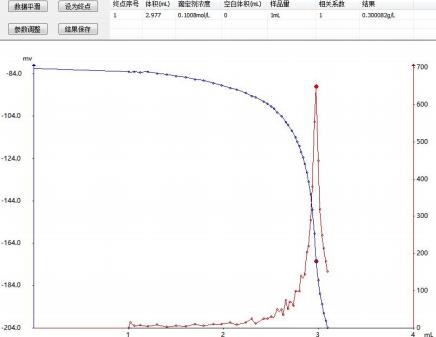
4.2 Atlas
4.3 Conclusion
It can be seen from the titration data and chromatogram that when the copper ion content in the PCB solution was determined by the potentiometric titrator, the absolute difference between the maximum and minimum values was only 0.2, with good repeatability. The more obvious the endpoint becomes, the more the instrument can automatically determine the endpoint, avoiding human errors in color judgment and making the results more accurate.
Keyword:
Full Automatic Potentiometric Titrator
WELCOME TO JIAHANG
Do you want to Send Inquiry ?

COMPANY CONTACTS
Office Tel: +86-177-2114-8861
E-mail:gm@jiahanglab.com
Factory: NO.3570 Jiasong north Rd, Jiading Dist, Shanghai , China
R&D Sales Center:
13F,BD1,Lane 925, Aksu South Rd, Jiading Dist Shanghai , China
Mob/Whatspp: 0086 177 2114 8861
Copy Right © 2023 Shanghai Jiahang Instruments Co., Ltd. All Rights Reserved
 0086 17721148861
 +86-17721148861
 E-mail